1.2.2 Delivering complaints
Here is the extract again.
Text 3
Parent visiting daughter; adapted from Traverso (2006: 5)
Text 3 - with actions
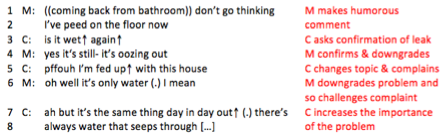
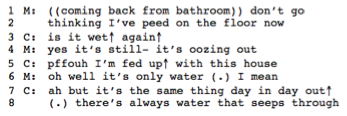
We noted earlier that M makes a humorous comment about water on the floor, by rejecting a potential cause of water on the floor. C’s request for confirmation uses the term ‘wet’ and suggests that it is a familiar state of affairs (‘again’ indicating at least one previous similar incident).
We also noted earlier that M confirms and downgrades this assessment. At line 4, ‘is it wet’ is re-described as ‘oozing out’. This works to downgrade because ‘oozing’ implies less water than ‘wet’ and a situation that is ‘in process’. At line 6 she does not take up C’s more general dissatisfaction and complaint (about the house), but further downgrades the problem – ‘it’s only water’.
At lines 7-8, C reformulates what makes the leak complaint-worthy (and therefore justifies the complaint).
Q: How does she do this? What terms does she use?
Hint
Note the use of the terms ‘same thing’, ‘day in day out’ and ‘always’. What do they imply?]
‘Always’ is an example of an ‘extreme case formulation’ (Pomerantz, 1986). Other examples include ‘everything’, ‘everywhere’, ‘brand new’, ‘no one else’. These terms indicate the maximum possible. They can be used to help legitimise claims, and to make a case more convincing. Here, describing the appearance of water as ‘always’ seeping through formulates the maximum case of seeping (always, constant) and helps justify the complaint-worthiness of the issue. We’ll see more extreme case formulations later.
The following complaint comes from an interview with a punk. Again, we can ask how the action (complaining) is done, and done legitimately. In other words, how does she pull this off as a reasonable complaint?
Text 8
(1) 1P:F:T1SA [KHS] from Widdicombe and Wooffitt, 1995:117
1 I: can you tell me anything ↑else
2 about (0.3) punk=what’s it like to be a punk,
3 (1.2)
4 R: it can be quite difficul(t)
5 ‘cos like when you wanna go into a pub
6 or something: you get (0.2) sor(t)’ve (0.4)
7 in some pubs they say “get out”
8 (‘cos) of the way you look.
9 (0.8)
10 I: yea:h.
(1) 1P:F:T1SA [KHS] from Widdicombe and Wooffitt, 1995:117
1 I: can you tell me anything ↑else
2 about (0.3) punk=what’s it like to be a punk,
3 (1.2)
4 R: it can be quite difficul(t)
5 ‘cos like when you wanna go into a pub
6 or something: you get (0.2) sor(t)’ve (0.4)
7 in some pubs they say “get out”
8 (‘cos) of the way you look.
9 (0.8)
10 I: yea:h.
The specific complaint is used to back up or illustrate the assessment that being a punk can be difficult. The complainable matter here is that she is not served in pubs.
Descriptions of activities often also indicate the categories or identities of people who do them. ‘Going to a lecture’, for example, implicates ‘student’ as the relevant identity of people who engage in this activity. But, as Widdicombe and Wooffitt point out, the activity of ‘going to a pub’ isn’t really associated with any particular group of people. It is an ‘anybody’s’ activity, or the kind of thing that ‘ordinary’ people do.
Q: How else could the activity ‘going to the pub’ have been described?
Descriptions of activities often also indicate the categories or identities of people who do them. ‘Going to a lecture’, for example, implicates ‘student’ as the relevant identity of people who engage in this activity. But, as Widdicombe and Wooffitt point out, the activity of ‘going to a pub’ isn’t really associated with any particular group of people. It is an ‘anybody’s’ activity, or the kind of thing that ‘ordinary’ people do.
Q: How else could the activity ‘going to the pub’ have been described?
Answer
‘Going for a few beers’, ‘a night out’, ‘going drinking’.
Going to the pub is usually a social activity, but this description makes no mention of friends or the social aspect of going to pubs.
Q: Think about the kinds of inference you could have drawn from slightly different versions of her description, such as ‘going to the pub with my friends’, or ‘going drinking’. What consequences could these alternative versions have for making a complaint about being refused service in pubs?
Hint
The speaker doesn’t refer to a specific incident. Instead, it’s implied that the reaction she describes in lines 6-7 is a general one.
Q: Can you point to aspects of this description that do this work?
Hint
Look at how a hypothetical case is built using the phrasing ‘when you ... then ...’; what other ‘generalising’ terms are used?
There are further features of the way she builds her complaint that are worth noting.
1. Use of reported speech. This speaker said the words ‘get out’ in such a way that they were heard as reporting speech, or repeating the actual words that are used. ‘Get out’ is an imperative which portrays what might otherwise be described as a request to leave, in very harsh terms. This helps build the credibility of her case, by suggesting that it really happened.
2. Use of contrast between activity and reaction. There is an implicit contrast between the activity, of going to a pub, and the response it receives, being told to ‘get out’. On the one hand, the terms used to describe ‘going to the pub’ portray it as a very ordinary activity. On the other, the reaction, ‘get out’ is rather extreme. So, there is an asymmetry between action and reaction which invites the recipient to see that the reaction is not warranted by the action.
3. Terms used to describe the reason for their reaction. The reason for this reaction is described as ‘(cos) of the way you look’
Q: How does this help to legitimise the complaint?
Hint
Again, think about the terms of description, and what is implied by using ‘the way you look’ as the basis of behaviour.