1.1 Core Section 1: Action
One key assumption in analysing language is that we use language to get things done. In this module, we are going to show what we mean when we say that ‘language is action’.
Let’s start with some data. It comes from one of a series of interviews about the Maori and Maori culture with white (Pakeha) New Zealanders. The interviewer has just asked whether the respondent thinks there is job discrimination against Maoris.
.Text 1
.Buttny in Van den Berg et al (2003:108)
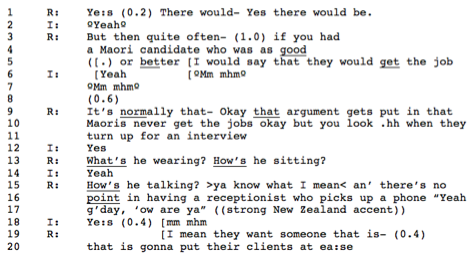
.Buttny in Van den Berg et al (2003:108)
Q: What do you think is going on? What actions are being done? Take a few moments to read through the extract and write down what actions you see being done.
Hint
Your notes might include ‘being prejudiced’, expressing an opinion, answering a question, justifying a state of affairs (job discrimination)
So, we can identify several actions that are achieved within this extract (and we’ll look at these in more detail later). But before we go on, it’s useful to note three important points.
1. This is an interaction, and in an interaction we need to look at what both parties are saying.
2. Actions unfold sequentially, one action follows another, so we need to take this into account in examining extracts.
3. Our analytic interest is in the action orientation of what’s said, rather than its content.
We’ll address each of these points in turn.