1.1.1 Actions as sequential
Our second, and related, point is that actions are done in a sequential manner, one after the other, because one action invites the next action, which is a response to it. So, co-ordinated activities are done over a series of turns. In addition, many actions have to be worked up and ratified by the other party.
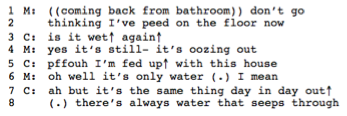
The following extract is part of a conversation between a daughter (C), and her mother (M) who is visiting her. At line 5, C produces a complaint , ‘I’m fed up with this house’ by stating her negative stance (‘fed up’) towards a ‘complainable matter’ (‘this house’). A key feature of the activity of complaining is getting others’ affiliation. This means that the recipient of the complaint doesn’t have to agree necessarily, but they need to show they recognise that the complaint teller’s negative stance is justified. In practice, this means that complaints can often be worked up over numerous turns until an affiliation is received.
The column on the right displays the actions being done at each turn. (In the next section, we’ll look more closely at how these actions are done).
Text 3
Parent visiting daughter; adapted from Traverso (2006: 5)
Text 3 - with actions

In this extract, we don’t see the outcome of this complaint sequence, but we do see that the complaint is built up and challenged over a series of turns.
At line 6, M challenges the complaint-worthiness of the situation, downgrading C’s general complaint to a more specific matter, and playing down the significance of the problem – ‘it’s only water’.
Q: What does C do in response on lines 7-8?
Answer
C rejects M’s (implied) viewpoint – ‘ah but’ - and expands the basis of her complaint, suggesting that it’s the frequency rather than the amount of water that’s the problem. Note that both C and M have already indicated their familiarity with the problem – ‘is it wet again?’ and ‘it’s still’ oozing out.
So, any one action is often part of a sequence of actions, which includes how the action is treated by and responded to by the recipient.