2.1.8 Advanced Section
In the core section we have covered the basic components (turn-constructional unit, transition-relevance-place) and rules of turn-taking (self-selection, other-selection) and how both the application and exploitation of these rules can lead to overlapping talk.
If you do not feel confident about these basic notions please return to the core section or glossary.
In this section we are going to practice further the mechanics. We will also go beyond the mechanics to examine how they provide resources for a variety of social actions as we shall see.
The conversation takes place between friends preparing to go out for the night. One of the participants, Ryan, is just leaving and he is the boyfriend of Anna.
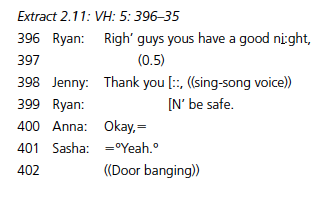
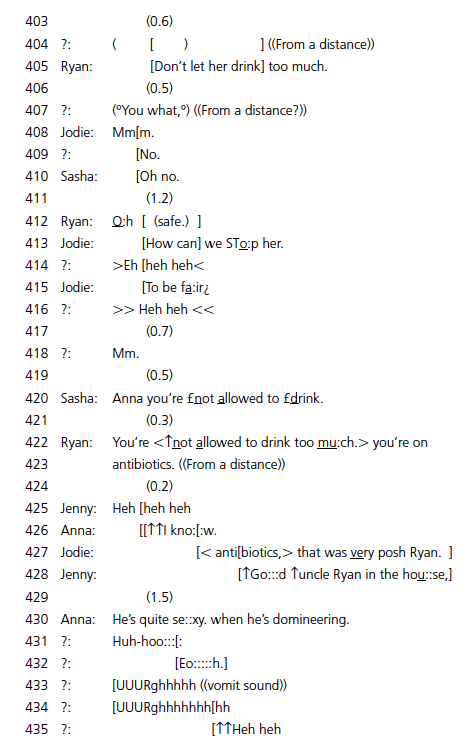
Read through the extract below and familiarize yourself with it. Lines 404, 407 and 422 sound as though they come from another room in the house. .
In the core section we have covered the basic components (turn-constructional unit, transition-relevance-place) and rules of turn-taking (self-selection, other-selection) and how both the application and exploitation of these rules can lead to overlapping talk.
If you do not feel confident about these basic notions please return to the core section or glossary.
In this section we are going to practice further the mechanics. We will also go beyond the mechanics to examine how they provide resources for a variety of social actions as we shall see.
The conversation takes place between friends preparing to go out for the night. One of the participants, Ryan, is just leaving and he is the boyfriend of Anna.
Read through the extract below and familiarize yourself with it. Lines 404, 407 and 422 sound as though they come from another room in the house. .
How long does this take
We spent a two hour session reading and working out each transcript we have used. Don’t worry if you see nothing, or, if it all seems obvious for the first fifteen minutes.
Text 11
(Extract. 2.11 from Benwell & Stokoe 2006: 80)
(Extract. 2.11 from Benwell & Stokoe 2006: 80)
Task 1
In the core section we have focused on selecting one speaker but situations commonly occur where the speaker is addressing a group. In the extract below four participants are involved in the activity of giving and receiving parting wishes. This activity involves two roles: the wishing party and the receiving party.
The question is: how do they construct these roles through turn-taking?
Excerpt from Text 11
Model Answer
Ryan says ‘guys’, thus constructing a group. Jenny then provides a receipt for the good wishes at line 398 and no other person does, thus suggesting she is speaking for everyone.
Ryan also then takes her thank you as sufficient to then move on to his next wish at line 399, note that this continues to select whole group though using “‘n” to append this to his previous turn.
Anna replies for whole group at line 400.
After ‘Okay’ it’s open for anyone to self-select and, at line 401, Sasha self-selects to agree with everybody.
‘Yeah’ seems to be summing up both Jenny and Anna’s responses to Ryan, which is then also closing off the parting wishes
Ryan also then takes her thank you as sufficient to then move on to his next wish at line 399, note that this continues to select whole group though using “‘n” to append this to his previous turn.
Anna replies for whole group at line 400.
After ‘Okay’ it’s open for anyone to self-select and, at line 401, Sasha self-selects to agree with everybody.
‘Yeah’ seems to be summing up both Jenny and Anna’s responses to Ryan, which is then also closing off the parting wishes
Imagine a different scenario where Jenny is in the wishing party (e.g. she’s staying home with Ryan) what consequences would this have on the talk?
Model Answer
Jenny can no longer take the next turn at line 398. Assuming Ryan didn’t do the wishing, Jenny could have done it because she is not part of the wishing party. Anna or Sasha would have to do the receipt instead at line 398. This shows that the structures of conversation, here the turn-taking machinery, are not bound to particular individuals.
Task 2
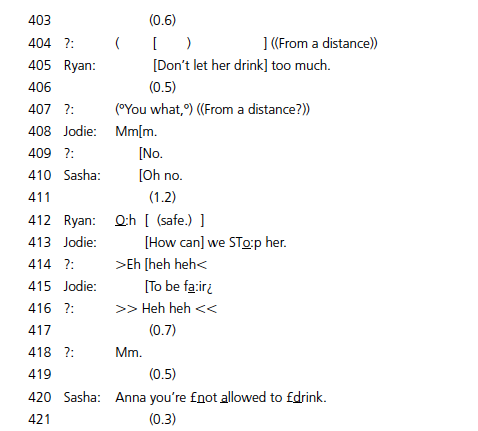
If you look at the extract below you will notice that Anna does not intervene in the talk. Even though, as line 420, makes clear, she is the object of the request. Using the turn-taking system can you explain why she doesn’t take a turn?
Excerpt from Text 11
Model Answer
In Ryan’s turn we have three entities: Ryan himself, ‘you’ (which is implied in “don’t” e.g. the elaborated form would be “don’t you”) and ‘her’. These correspond to the instructor, the instructed (i.e. the people going out, other than Anna) and the target of the instruction (i.e. Anna). By excluding Anna from the instructed Ryan is de-selecting her from potential next speaker. Jodie’s ‘How can we stop her’ confirms Ryan’s de-selection of Anna because the ‘her’ continues to treat her as the object of the talk, and therefore, the re-casting of the group as one which excludes Anna. So, Anna does not take a turn because she has been excluded at lines 405 and 413. The only way she could have intervened is to break the turn-taking rule, which she did not do.
Task 3
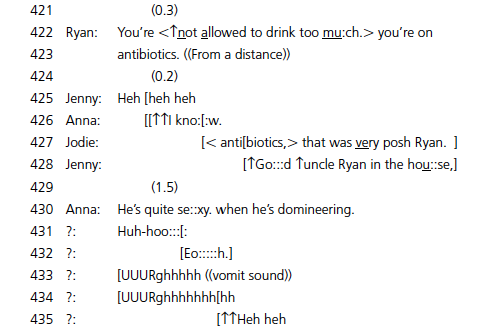
In this particular section an embarrassing situation has occurred where Ryan has put Anna in a position where she is seen as not being responsible for her own actions. How do the participants go about managing the embarrassment through using elements of the turn-taking system?
Excerpt from Text 11
Model Answer
At line 420 Sasha brings Anna back into the conversation, which she has been excluded from, by addressing her directly. However Anna does not respond at this point and there is a brief pause before Ryan instead selects himself at line 422 in violation of the rule.
Why does he violate the rule? Note that Sasha selectively recycles his talk from line 405 (‘don’t let her drink too much’), while exaggerating it, by missing out the ‘too much’. In other words she implies that Ryan’s instruction is that Anna must not drink at all. In so doing she portrays herself as only doing what Ryan has instructed them to do. But in fact she’s not being serious as indicated by the smiley marks around her talk. Also note that the instruction is issued at an inappropriate time as they were supposed to be monitoring her drinking later. All this then forces Ryan onto the defensive, correcting and restating his instruction, and providing an account for it. In summary Ryan violates the rule in order to repair the implication of Sasha’s remark at line 420.
Line 427 selects Ryan as next speaker, line 428 overlaps with 427 but does not select an alternative next speaker (or indeed any speaker specifically) therefore Ryan’s selection at 427 stands. Ryan would be expected to speak at line 429 and doesn’t, producing a “silent” response (represented by 1.5 second pause). The response because it’s silent does not select a next speaker and therefore anybody can self-select. And indeed at line 430 Anna self-selects and in a mirror image of Ryan’s earlier actions, she excludes Ryan as potential next speaker by using ‘he’ (‘you’re quite sexy’ would have selected him). This time he is the object of a humorous assessment as evidenced by the chorused response from the other participants in lines 431-35.
The embarrassment managed is managed through recycling of turns, providing an account for the instruction, doing a silent turn and taking the opportunity to have your own back! All this is managed through the machinery of turn-taking.
Why does he violate the rule? Note that Sasha selectively recycles his talk from line 405 (‘don’t let her drink too much’), while exaggerating it, by missing out the ‘too much’. In other words she implies that Ryan’s instruction is that Anna must not drink at all. In so doing she portrays herself as only doing what Ryan has instructed them to do. But in fact she’s not being serious as indicated by the smiley marks around her talk. Also note that the instruction is issued at an inappropriate time as they were supposed to be monitoring her drinking later. All this then forces Ryan onto the defensive, correcting and restating his instruction, and providing an account for it. In summary Ryan violates the rule in order to repair the implication of Sasha’s remark at line 420.
Line 427 selects Ryan as next speaker, line 428 overlaps with 427 but does not select an alternative next speaker (or indeed any speaker specifically) therefore Ryan’s selection at 427 stands. Ryan would be expected to speak at line 429 and doesn’t, producing a “silent” response (represented by 1.5 second pause). The response because it’s silent does not select a next speaker and therefore anybody can self-select. And indeed at line 430 Anna self-selects and in a mirror image of Ryan’s earlier actions, she excludes Ryan as potential next speaker by using ‘he’ (‘you’re quite sexy’ would have selected him). This time he is the object of a humorous assessment as evidenced by the chorused response from the other participants in lines 431-35.
The embarrassment managed is managed through recycling of turns, providing an account for the instruction, doing a silent turn and taking the opportunity to have your own back! All this is managed through the machinery of turn-taking.