2.1.5 Self-selection (Rule 2)
If the current speaker does not select a next speaker then one of two things will happen:
a. Current speaker can keep the turn
If you remember our earlier transcript where we practiced identifying possible transitional relevance places we can now re-examine it with Rule 2a in mind:
If the current speaker does not select a next speaker then one of two things will happen:
a. Current speaker can keep the turn
If you remember our earlier transcript where we practiced identifying possible transitional relevance places we can now re-examine it with Rule 2a in mind:
Text 4 Pridham, (2001: 14)

Nobody has self-selected at any of those places therefore Richard keeps adding more TCUs until eventually Raj, R & J came in with laughter.
b. Anybody else can self-select.
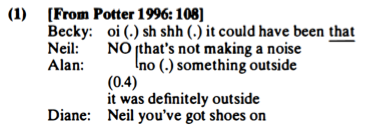
The second possibility is that another participant self-selects and produces a new turn. In the example below, Becky does not select next speaker therefore both Neil and Alan self-select at almost the same time, which produces two new turns.
Text 5 Potter p205 in Hutchby & Wooffitt
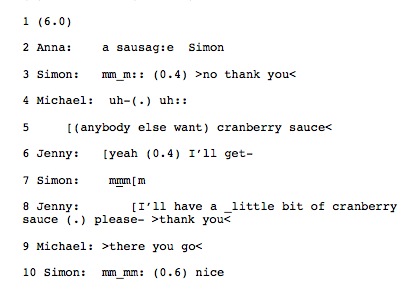
Have a look at the extended transcript of the earlier example (Text 3). What do you think is happening on line 5:
Text 6 Simplified from Wiggins (2002: 319)
Answer
‘Anybody’ by itself invites self-selection but ‘anybody else’ excludes the speaker Michael who’s presumably had a dollop of sauce already. And indeed Jenny self-selects.